
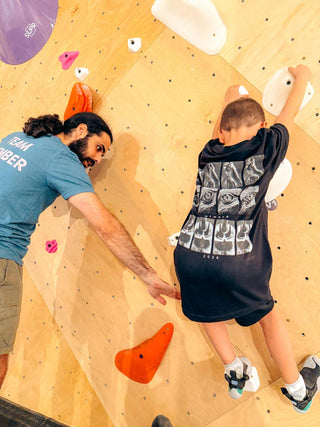
The Quiet Difference Between Climbing Alone and Climbing With Guidance
There is something satisfying about figuring out a climb by yourself.
You look at the holds, make a plan, try a movement, miss it, and try again. Eventually you may find a way through. That independence is part of what makes climbing enjoyable.
But there is another experience that can feel very different.
Someone watches how you move, notices something you have not noticed yourself, and offers one small adjustment. Maybe it is your foot position. Maybe it is where you are placing your weight. Maybe you are gripping a hold harder than necessary.
Sometimes one piece of feedback can change the way an entire climb feels.
That is the quiet difference between climbing alone and climbing with guidance. It is not about having someone solve the climb for you. It is about gaining another set of eyes when your own perspective is limited by being inside the movement.
What You Can See From the Wall — and What You Can’t
When you climb alone, your attention is naturally on the next hold, your balance, and whether the move is possible. You are inside the effort. That makes it difficult to notice the smaller details shaping the movement.
Your hips may be farther from the wall than you realize.
Your foot may be on the hold, but not on the useful part of it.
Your hands may be working much harder than the sequence requires.
From the outside, those things are often obvious. From the inside, they can be almost invisible.
That gap is where guidance becomes useful. Not as a replacement for your own problem-solving, but as information you would otherwise have to discover more slowly.
One Adjustment Can Change the Whole Climb
When a move is not working, the instinct is usually to try harder. Change the grip. Pull more. Move faster. Try again.
Without feedback, it is easy to repeat the same attempt with more effort and still miss the actual issue.
A useful piece of guidance is often simple:
“Try moving your hips first.”
“Trust that foot more.”
“You don’t need to squeeze that hold as hard.”
One clear adjustment can make the same climb feel completely different. The holds did not change. Your available strength did not suddenly increase. The way you organized the movement did.
That is one of the quiet advantages of climbing with guidance: it can separate a true strength limit from a movement problem.
The Difference Is Not Control — It Is Information
There is a common concern that instruction will take over the process and remove the satisfaction of figuring things out.
Good guidance does the opposite.
It gives you information. You still have to make the movement. You still have to decide how to approach the next sequence. You still feel the difference when something works.
The climb remains yours. You just spend less time stuck in the same unsuccessful pattern.
This is especially noticeable for beginners, when it is hardest to tell whether a movement feels difficult because it is hard or because the body is working against itself. Structured climbing classes are designed to make those distinctions clearer while still leaving room for people to climb and solve problems themselves.
What Starts to Change Over Time
The most useful outcome of guidance is not that you always need someone watching.
It is that you begin noticing more on your own.
You start to feel when your feet are poorly placed.
You notice when you are over-gripping.
You sense when your body is out of balance before you commit to the next move.
There is a major difference between thinking, “I need to get better at climbing,” and thinking, “I need to work on my foot placement.” The second gives you something specific to practice. That specificity is often what makes independent sessions more productive later.
In that sense, guidance and solo climbing support each other. Instruction provides clearer information. Time alone on the wall is where you apply it.
Both Experiences Have a Place
Climbing alone gives you freedom. You can experiment, repeat climbs, and discover solutions in your own way. That independence matters.
Climbing with guidance adds something quieter: perspective. Another set of eyes can see patterns that are difficult to detect while you are the one moving.
Neither approach has to replace the other. Many climbers benefit from using both — receiving clear feedback when they need it, then returning to independent climbing with a better idea of what to pay attention to.
The quiet difference is not that one way is more serious or more legitimate. It is that feedback changes what you are able to notice. And once you can notice more, your own climbing starts to teach you more as well.
Ready to feel the difference for yourself?
Come experience Las Rocas Climbing & Fitness at 9600 S Dixie Hwy, South Miami. First-timers receive a free day pass with no commitment.
Frequently Asked Questions
Is it better to climb alone or take climbing classes?
Neither approach is automatically better for everyone. Independent climbing provides freedom to experiment and practice at your own pace, while classes provide structured guidance, feedback, and instruction.
Are climbing classes good for beginners?
Yes. Las Rocas says its climbing classes are designed to support beginners and focus on technique, movement, safety, and controlled progression.
Can I learn rock climbing without taking a class?
Yes. Las Rocas states that climbers can progress at their own pace whether they are taking classes or climbing independently.
What do climbing classes teach?
Las Rocas says its climbing classes focus on technique, movement, safety, and controlled progression. The exact content can vary depending on the class and current schedule.
Do I need to be experienced before taking a climbing class?
No. Las Rocas specifically states that its rock climbing classes support beginners as well as more experienced climbers.
Can I take a class during my first visit?
Yes. Las Rocas' First Visit page says guests can take classes and use the facility's amenities during their visit.
