
Why Most Beginners Feel Stronger After Climbing Than After the Gym
Most people finish a regular gym session knowing they worked hard.
They tracked the sets. They felt the burn in familiar places. They left tired in a way they recognized.
Then they try indoor climbing for the first time.
The session may not look as structured. There are no machines counting repetitions. But when they step off the wall, something feels different. The forearms are heavy. The legs feel used in a way they didn’t expect. The whole body seems more involved than usual.
It leaves many beginners with the same quiet question:
Why does climbing make me feel stronger than the gym did?
The answer is not that one climbing session suddenly builds more muscle. It is that climbing asks the body to work in a way most gym routines do not.
The Effort Feels Unfamiliar
In a typical strength session, the body knows what is coming. A squat is a squat. A pull-up is a pull-up. The movement pattern is controlled and repeated.
Climbing removes that predictability.
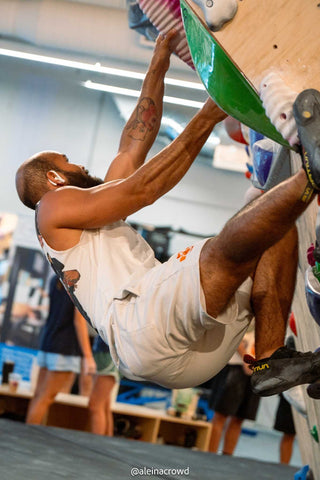
You reach for a hold while your feet stay on the wall. You shift your hips to stay balanced. You adjust mid-move when the next hold feels farther than expected. Strength has to show up while balance, timing, and body position are also being tested.
That combination is new for most people. And unfamiliar effort is often felt more intensely than familiar effort, even when the total work is similar.
This is one reason the first few climbing sessions can leave a stronger physical impression than a normal gym day.
Your Legs Are Doing More Than You Think
Many beginners assume climbing is mostly upper body.
It makes sense. Your hands are on the wall, so the natural reaction is to pull.
But efficient climbing relies heavily on the legs and feet. Pushing through the feet, placing them accurately, and shifting weight onto them reduces how much the arms have to do. Beginners usually discover this the hard way — after their arms tire early and their legs feel surprisingly worked.
The more someone learns to trust their feet, the less the session feels like a pure pulling workout. That shift is part of what makes climbing feel different from most strength training.
The Forearms Tire for a Reason
Another early surprise is how quickly the forearms pump out.
This is not always a pure strength problem. New climbers often grip harder than necessary because the wall still feels uncertain. That extra tension speeds up fatigue.
As movement improves, the same holds often feel more manageable — not because the person became dramatically stronger overnight, but because they stopped squeezing every hold as if it might disappear.
Las Rocas has explored this more closely in its piece on whether grip strength is really the limiting factor. The short version is that technique and body position often change the demand on the hands more quickly than pure grip training does.
Strength Has to Work While You Move
This is the clearest difference between climbing and many gym exercises.
In the weight room, strength is often expressed in a stable position. On the wall, strength has to work while the body is shifting, balancing, and deciding what comes next. The core stays involved. The hips matter. Timing matters.
That is why climbing can feel like more of a full-system demand, especially at the beginning. It is also why people who already lift regularly can still feel worked after their first sessions on the wall.
So, is rock climbing good for fitness? Yes — because it combines strength with coordination, balance, body control, and sustained attention. The exact demand changes from climb to climb, but the overall effect is different from isolated strength work.
The Feeling Changes as You Improve
The strong “I feel completely worked” impression is often strongest in the first weeks.
As footwork improves, as unnecessary tension drops, and as body position becomes more natural, the same climbs start to feel less costly. Progress shows up not only as harder grades, but as the ability to do more work with less wasted effort.
This is one reason structured climbing classes can help. Clear feedback on movement shortens the period where beginners are working much harder than they need to.
Climbing and traditional strength training can also sit side by side. Many people use both. Las Rocas is set up for that combination, with climbing alongside a full fitness area for strength and conditioning work.
What the First Sessions Are Really Showing You
The reason beginners often feel stronger after climbing than after the gym is not magic.
It is novelty, coordination demand, and the need to use strength while the rest of the body is also solving a problem. The arms, legs, core, and attention all get involved at once.
That combination can make a single session feel more complete than a workout built from separate exercises.
Once the movements become more familiar, the raw “worked all over” feeling usually softens. What remains is a form of training that still challenges strength — just in a more connected way.
The climbers who stick with it are often the ones who notice that difference early and want more of it.
Ready to feel how climbing uses strength differently?
Come experience Las Rocas Climbing & Fitness at 9600 S Dixie Hwy, South Miami. First-timers receive a free day pass with no commitment.
Frequently Asked Questions
Is rock climbing good for fitness?
Yes. Rock climbing can provide a demanding form of physical activity involving strength, balance, coordination, body control, mobility, and concentration. The exact physical demands vary depending on the climb and the climber.
Does climbing build strength?
Climbing can challenge and develop strength through repeated climbing practice, but the amount and type of strength development will vary. Climbing also requires technique, coordination, balance, and efficient movement.
Is climbing better than going to the gym?
There is no universal answer. Climbing and traditional gym training provide different types of physical training. Climbing combines movement, balance, coordination and problem-solving, while structured strength training can target specific physical qualities.
Why do my arms get tired so quickly when climbing?
Beginners may grip holds tightly or rely heavily on their arms while learning how to climb. Technique, body positioning, foot placement and grip efficiency can all affect how quickly the arms and forearms become tired.
Can beginners start indoor climbing without being strong?
Yes. Las Rocas welcomes first-time climbers, and beginners do not need to arrive as experienced athletes. The first visit includes orientation and guidance to help new climbers become comfortable with the climbing environment. (Las Rocas First Visit)
