
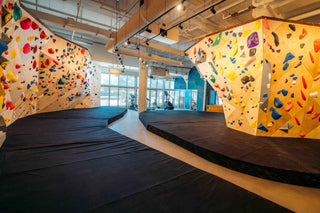
Let's be honest — trying something completely new as an adult can feel awkward. You don't know the terminology, you're not sure what to wear, and you're quietly wondering if you're going to embarrass yourself in front of people who clearly know what they're doing.
We get it. And we want to tell you: it's not like that here.
Rock climbing classes at Las Rocas are designed for real beginners — not just people who say they're beginners but secretly have athletic backgrounds. Actual beginners. People who have never touched a climbing wall in their lives. Here's exactly what to expect.
Before You Walk In
You don't need to bring anything special. Wear comfortable athletic clothes you can move in. We provide climbing shoes for your first session — once you're hooked, you'll want your own pair, but that's a later conversation.
Show up a few minutes early. You'll check in, get your gear sorted, and have a moment to look around and get comfortable with the space before anything starts.
The First Thing We Cover: Safety
Your instructor will walk you through how Las Rocas works — the different types of walls, how to read route markings, and the basic safety rules that apply to everyone in the gym.
If you're bouldering (climbing without a rope, on shorter walls with padded floors beneath), the safety intro is pretty quick. If your class includes roped climbing, you'll also learn how to use a harness and the basics of belaying — the system that keeps a climbing partner safe.
None of this is complicated. Most people are ready to start climbing within 15 minutes of arriving.
The Actual Climbing Part
Your first routes will be intentionally easy. That's not condescending — it's strategic. The easiest routes teach you the most important fundamentals: where to put your feet, how to shift your weight, and how to read what the wall is asking you to do.
Here's what surprises almost every first-timer: climbing is way less about arm strength than they expected. The people who progress fastest are the ones who learn to trust their feet and use their legs early. That's what the instructor is there to help you develop.
What Your Instructor Is Actually Watching For
During your session, your instructor will give you real-time feedback on:
-
Foot placement — are you using the full surface of the hold, or just your toes?
-
Hip positioning — are you staying close to the wall, or swinging out?
-
Straight arms — keeping your arms extended when possible conserves enormous energy
-
Breathing — yes, people forget to breathe when they're nervous on the wall
The feedback isn't judgment — it's the fastest way to help you improve. The technical adjustments that feel small in the moment make a huge difference in how long you can climb before fatiguing.
Common Questions We Hear From First-Timers
'Do I need to be strong?'
No. Technique matters far more than raw strength at the beginner level, and strength develops naturally as you climb more. Many women outclimb much stronger men within months of starting, purely through better footwork and movement efficiency.
'What if I can't make it to the top?'
That's normal, and it's fine. In bouldering especially, a route you can't complete today is just a project for next time. The goal of your first class isn't to top every route — it's to get comfortable on the wall and start building your movement vocabulary.
'Is it safe?'
Yes. Our walls are padded, our instructors are trained, and the environment is designed for safe progression. Climbing has a strong safety culture, and that starts in class.
After Your First Session
Most people finish their first climbing class feeling two things: more tired than expected, and immediately wanting to come back.
The muscle soreness you'll feel in the next day or two is real — forearms, back, and sometimes your feet. That's your body adapting. It gets easier fast.
More importantly, you'll leave with a clearer sense of what climbing actually is. Not a sport for daredevils or elite athletes — a movement practice that anyone can learn and that genuinely rewards the time you put into it.
Ready to try it for yourself?
Come experience Las Rocas Climbing & Fitness at 9600 S Dixie Hwy, South Miami. First-timers get a free day pass — no commitment, no pressure. Just show up and climb.
