
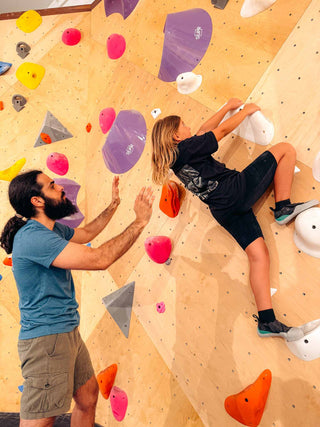
Here’s something most beginners don’t expect: the first real skill you learn in bouldering isn’t climbing up. It’s coming down. Every boulderer falls, from first-timers to pros working their hardest project. The difference is that experienced climbers fall well, because they’ve practised it until it’s automatic.
The good news is that falling safely is simple to learn. It takes a few minutes of practice and a handful of habits you’ll use every session. That’s why good climbing lessons for beginners teach landing before anything else. Here’s exactly how to fall, land and downclimb, so you can climb with confidence instead of worry.
Why bouldering falls are different
In roped climbing, a rope and a partner catch you. In bouldering, there’s no rope. You climb shorter walls, and when you come off, you land on thick padding below.
That makes bouldering simple and social: no harness, no knots, no partner needed. But it also means every fall ends with you landing on your own two feet. At Las Rocas, most walls are 14 feet off the pads. That’s high enough that how you land really matters, and low enough that a good landing technique makes falling a normal, non-scary part of climbing.
The padding does a lot of work. Your technique does the rest.
Check your landing zone first
A safe fall starts before you leave the ground. Before every attempt, look at the pads under the problem and ask yourself three questions:
• Is anyone in my fall zone? People walking past or sitting on the pads are the biggest hazard in a bouldering gym.
• Is anything on the pads? Water bottles, phones, brushes and shoes are all things you could land on.
• Where will I fall from? Look at the hardest move. If you come off there, where will your body go?
If anything’s in the way, wait or ask people to move. Our guide to climbing gym etiquette explains how to share the fall zone with everyone else.
The 5-step landing
This is the core technique. Learn it on the ground, practise it from low heights, and it will become automatic.
1. Look down. As soon as you know you’re coming off, glance at where you’re going to land. It takes a split second and lets your body prepare.
2. Land feet first, shoulder-width apart. Aim to land on both feet at the same time, with your feet roughly shoulder-width apart. A wide, stable base spreads the impact and stops you from rolling an ankle.
3. Bend your knees. Soft knees absorb the landing. Let your legs bend as you touch down, like landing a jump. Stiff, straight legs send the shock straight through your joints.
4. Sit and roll back. Once your feet have taken the first impact, keep going. Sit down onto your bottom and roll back onto your rounded back. This spreads the force over a much bigger area of your body. Think “feet, bottom, back.”
5. Keep your arms in and your chin tucked. As you roll, keep your arms close to your body, with your hands near your chest. Tuck your chin so your head doesn’t hit the mat. And never put your hands out behind you to catch yourself. Your wrists aren’t built to stop a fall from 14 feet.
That’s it: look, feet, bend, roll, tuck. Run through it a few times on the floor before you climb. It feels silly for about a minute, and then it feels like second nature.
Downclimb whenever you can
The safest fall is the one you don’t take. When you finish a problem, or decide to stop part-way, climb down instead of jumping. Use the biggest holds you can find, including holds from other problems, to get as low as possible. Then step or drop the last short distance onto the pads.
Downclimbing has extra benefits too. It builds strength and footwork, it gives you more time on the wall, and it teaches you to move in control. Most experienced climbers downclimb almost every problem, even when they don’t strictly need to.
Controlled falls vs unexpected falls
Not every fall is the same.
A controlled fall is one you choose. You’re tired, you can’t do the next move, or you’ve finished the problem and can’t downclimb. You let go on purpose, so you can set up your landing: look down, square your body and drop.
An unexpected fall is one that surprises you. A foot slips, a hold feels worse than expected, or you miss a jump. These are harder to land, because you have less time to react. That’s why practising the 5-step landing matters. When it’s automatic, your body does it even when your brain is still catching up.
A good habit: if a move feels risky, decide before you try it what you’ll do if you come off. Climbers call this “knowing your fall.”
Falling on slab, vertical and overhang
Where you fall from changes how you fall. If you’re new to wall angles, our guide to slab, vertical and overhang climbing explains each one.
• Slab (a wall leaning away from you): you tend to slide or stumble down the wall. Push gently away from the wall as you let go, so you don’t scrape your knees or catch a foot on a hold on the way down.
• Vertical: falls are usually straight down. This is where the 5-step landing works best.
• Overhang (a wall leaning toward you): you’ll swing out from the wall, and you may fall from a sideways or upside-down position. Let go cleanly, try to get your feet under you, and expect to land further from the wall than you started.
Wherever you climb, remember that your fall zone is bigger on steep walls. Check it before you start.
Common falling mistakes (and how to fix them)
|
Mistake |
Why it’s a problem |
Fix it |
|
Putting your hands out |
Wrists and elbows take the full impact |
Keep your arms in, hands near your chest |
|
Landing with stiff legs |
The shock goes straight into your knees and back |
Bend your knees as you touch down |
|
Twisting in the air |
You can land sideways and roll an ankle |
Look down early and square your body to the mat |
|
Jumping from the top |
You fall from the highest possible point |
Downclimb as far as you can first |
|
Landing on something on the pads |
Bags, bottles and phones can twist an ankle |
Clear the pads before every attempt |
|
Falling onto another person |
Both people can get hurt |
Check your fall zone and wait for it to clear |
Practise falling: a 3-step drill
Falling is a skill, so practise it like one. Try this at the start of your next few sessions:
Step 1: From the ground. Stand on the pads, squat down, sit back and roll onto your back with your arms in and your chin tucked. Repeat 3–5 times until it feels smooth.
Step 2: From low on the wall. Climb onto an easy problem with your feet about 2–3 feet off the ground. Let go on purpose and do the full landing: feet, bend, roll. Repeat 3–5 times.
Step 3: From halfway up. Once you’re comfortable, climb to about halfway on an easy problem and take a controlled fall. Only go higher when the lower falls feel completely relaxed.
Do it with a coach the first time if you can. They’ll spot little habits, like reaching back with your hands, before they become a problem.
Other safety habits every boulderer should have
Landing technique is the biggest piece, but a few more habits make every session safer:
• Warm up. Start with easy problems and some light movement. Warm muscles move better and react faster.
• Climb within your limits. Build up grades slowly, and save your hardest attempts for when you’re fresh.
• Rest between attempts. Tired arms lead to unexpected falls.
• Speak up about loose holds. If a hold spins or feels loose, stop and tell a member of staff.
• Learn from others. REI’s guide to bouldering basics and our list of common rock climbing mistakes are both worth a read.
Is indoor bouldering safe?
Like any sport, climbing has some risk. Indoor bouldering is designed to manage it. The walls are built for climbing, the floor is padded, routes are set with safe falls in mind, and staff are on hand to help.
The biggest factor is you: how you land, how you check your fall zone and how sensibly you build up. If you’re wondering whether climbing is right for you, our guide on is indoor rock climbing beginner-friendly answers the most common first-timer questions. And if you have an injury or health condition, check with your doctor before you start.
For parents: kids and falling
Kids are often natural climbers, and they usually pick up falling quickly too. Teach them the same basics: feet first, bend, roll and keep their arms in. Practise on the ground together before they climb.
Keep kids close and supervised, encourage them to climb down rather than jump, and make sure they know to stay out of other climbers’ fall zones. Ask staff about any rules for children when you arrive.
How to fall safely: FAQ
Is indoor rock climbing safe?
Indoor climbing is designed with safety in mind, with padded floors, purpose-built walls and trained staff. Like any sport it has some risk, and learning how to fall and land well is the best way to reduce it.
Is bouldering safe for beginners?
Yes, when you learn the basics first. Start on easy problems, practise landing from low heights, and climb down whenever you can. A coached intro session is the best way to start.
How high are the walls at Las Rocas?
Most of our bouldering walls are 14 feet off the pads.
Should I jump down from the top of a problem?
Avoid it. Downclimb as far as you can using the biggest holds, then drop the last short distance and land with bent knees.
What if I fall onto my back?
Rolling onto your back is part of a good landing, as long as your feet and bottom take the impact first and your chin is tucked. The aim is to spread the force, not stop it in one place.
Do I need a crash pad indoors?
No. The bouldering area has thick padded flooring. Crash pads are for outdoor bouldering, where you bring your own padding.
Learn to fall with a coach
The fastest way to fall with confidence is to practise with someone watching. Book an Intro to Climbing + Day Pass ($60): a coached lesson with landing practice, shoe and chalk rentals, and the rest of the day to climb. Your first-visit safety orientation covers the basics before you start.
Already know you’ll be back? Buy a day pass and, if you join the same day, we’ll put it toward your membership.
