
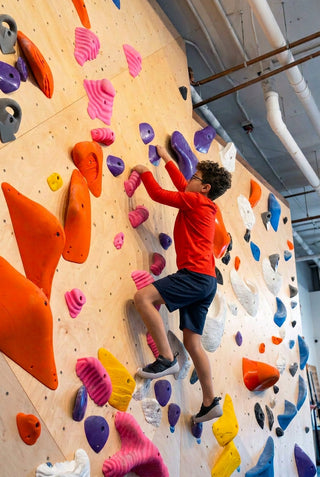
How Climbing Quietly Changes the Way You Move Through the Rest of Your Day
Most people judge climbing by what happens on the wall.
They notice stronger forearms, better balance, or the ability to stay on a route longer than before. Those changes are real. They are also only part of the story.
After a while, some climbers start noticing smaller shifts that have nothing to do with grades.
They stand differently while waiting in line.
They pick things up with more attention to balance.
They catch themselves adjusting their posture at a desk without thinking about it.
Climbing begins to influence ordinary movement.
You Become More Aware of Your Body in Space
On the wall, you are constantly managing where your weight is, how your hips relate to your feet, and whether your body is organized before you reach. That awareness does not switch off completely when the session ends.
Over time, people often become more sensitive to awkward positions in daily life. Slouching feels more noticeable. Twisting to grab something feels less automatic. The body has practiced paying attention, and some of that attention carries over.
Posture Starts to Matter in Smaller Moments
Climbing rewards a stacked, efficient body position. Hips close to the wall. Shoulders organized. Feet doing real work.
Those preferences can show up later when someone is standing at a counter, carrying bags, or sitting for long periods. The change is rarely dramatic. It is more like a quiet correction that happens sooner than it used to.
This is one reason climbing pairs well with mobility work and yoga. The wall creates the demand for better organization. Other movement practices help maintain it off the wall.
Everyday Tasks Start to Feel More Coordinated
Climbing is full of linked actions. Foot, hip, hand, shift, reach. The body learns to sequence effort instead of isolating it.
That sequencing can make ordinary tasks feel slightly more coordinated. Lifting, reaching, stepping up, or moving through tight spaces becomes less about forcing one muscle group and more about using the whole system. People do not always describe it in technical terms. They just notice that movement feels a little more intentional.
Some of this carry-over also shows up for people who already strength train. Climbing asks the body to organize force under changing balance, which is a different demand from most fitness work. The combination can make daily movement feel more connected.
The Change Is Gradual, Not Instant
None of this happens after one session.
It builds through repeated practice, especially when climbing is consistent enough for movement patterns to settle. Two or three quality sessions a week, supported by recovery and attention to how you move, is often enough for people to start noticing the carry-over.
The effect is easy to miss if you only track progress by difficulty. It becomes clearer when you pay attention to how you move when you are not climbing at all.
If you are still figuring out how often to climb, that consistency question matters more than intensity at the beginning. Steady practice is what lets these quieter changes show up.
Why This Matters Beyond the Gym
A lot of exercise stays inside the session. You work, you fatigue, you leave, and daily movement remains mostly unchanged.
Climbing has a better chance of leaking into the rest of life because it trains coordination and body awareness under changing conditions. Those qualities are useful long after you step off the wall.
The climbers who notice this earliest are usually not chasing dramatic transformation. They simply stay with the practice long enough for small adjustments to become normal. For many, that is also the point where a regular membership starts to make more sense than occasional visits.
Ready to see how climbing carries into the rest of your day?
Come experience Las Rocas Climbing & Fitness at 9600 S Dixie Hwy, South Miami. First-timers receive a free day pass with no commitment.
