
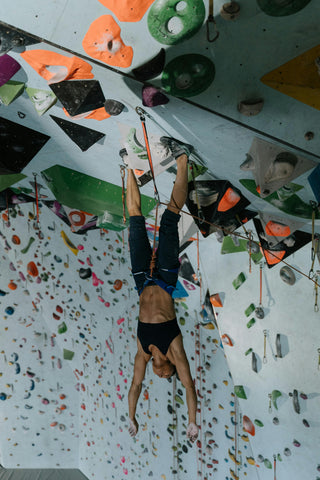
If you've started climbing in Miami, you've probably hit this crossroads pretty quickly: should you be hitting the weights, or focusing on mobility and movement? It's one of the most common questions new climbers ask — and the answer is more interesting than you'd expect.
Spoiler: it's not really either/or. But understanding why changes how you train.
What strength training actually does for climbers
Strength training — think deadlifts, pull-ups, resistance work — builds your body's capacity to generate force. For climbing, that matters more as routes get harder. Stronger forearms mean better grip on smaller holds. A stronger back means more pulling power on steep terrain. Targeted strength work also helps prevent the overuse injuries that sideline a lot of newer climbers.
But here's the catch: strength alone doesn't make you a better climber. It just gives you more raw material to work with.
What functional fitness does differently
Functional fitness is about how your body moves — coordination, balance, core stability, and the ability to transfer force across multiple planes of movement at once. Instead of isolating one muscle, it asks: how well do all the parts work together?
This is where climbing gets interesting.
Climbing is already functional training
Every route you climb requires real-time problem-solving, full-body coordination, precise weight shifts, and hip positioning that no machine can replicate. A climber who moves efficiently — who knows how to trust their feet, engage their core, and read a route — will consistently outperform a climber who just pulls harder.
This is why beginners at Las Rocas often make their biggest gains not by getting stronger, but by getting smarter on the wall. Technique compounds fast.
So which one should you prioritize?
For most people new to climbing in Miami, the order looks like this:
- Learn to move well first. Technique and footwork will get you further faster than any training program.
- Let climbing build your baseline strength. You'll naturally develop grip, core, and pulling power just by climbing consistently.
- Add targeted strength work as you progress. Once you're climbing regularly, supplemental training can help you push into harder grades.
Neither approach replaces the other. Strength gives you capacity. Functional movement teaches you how to use it. Climbing is where both come together.
FAQs
Is strength training necessary for rock climbing? Not at the start. Beginners typically progress faster by focusing on technique and climbing consistently. Strength training becomes more valuable as routes get harder.
What type of fitness is best for climbing? A combination of both — functional movement for efficiency and strength training for capacity. Most climbers benefit from prioritizing movement quality first.
Does climbing build strength on its own? Absolutely. Climbing is a full-body workout that develops grip strength, core stability, and pulling power naturally over time.
Should beginners lift weights before climbing? It's not necessary. Many new climbers at Las Rocas see significant early progress just by climbing 2–3 times a week and dialing in their footwork.
Ready to find out what your body can do? Las Rocas Climbing is Miami's newest climbing and fitness gym — built for beginners and experienced climbers alike. Come check us out!
