
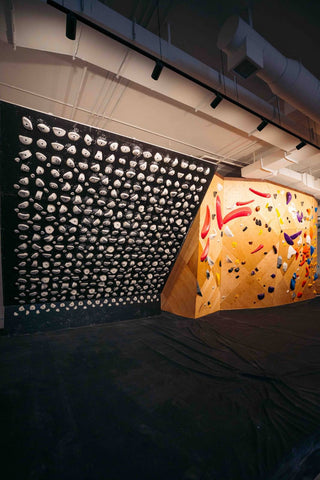
Most bouldering gyms have one wall that looks different from the rest. It’s steep and covered in hundreds of small holds, each with a light underneath. Someone taps their phone, a pattern of colored lights appears, and a climber starts moving. That’s a Kilter Board.
At Las Rocas, ours sits next to more than 3,000 square feet of bouldering. It’s one of the reasons climbers come to us for rock climbing in Miami. Here’s what the board is, how it works and how to use it to get better.
What is a Kilter Board?
A Kilter Board is an app-controlled climbing training wall. Every Kilter Board with the same layout has the same holds in the same positions. LED lights under each hold show which ones belong to a problem. You pick a problem in the Kilter Board app, the board lights it up, and you climb using only the lit holds.
That standard layout is the whole idea. A problem at a given angle on our board in South Miami is the same climb as on the same layout anywhere else in the world. So the board gives you a shared library of thousands of problems, set and graded by climbers everywhere.
How does a Kilter Board work?
Three things work together: the app, the lights and the angle.
The app. You connect your phone to the board over Bluetooth. Then you browse problems and filter them by grade, angle and how highly other climbers rate them. You can also log your sends and save problems you want to come back to.
The lights. Each color tells you how to use a hold:
|
Light color |
What it means |
|
Green |
Start holds. Begin with your hands here. |
|
Blue |
Hand holds you can use on the way up |
|
Purple |
Finish hold. Match or control it to complete the problem. |
|
Orange |
Feet only |
The angle. The board tilts. The steeper it gets, the harder each problem becomes, and it takes more pulling power and core tension. At lower angles your feet do more of the work, and climbing feels closer to a vertical gym wall. The app grades every problem at each angle, so you always know what you’re getting into.
Kilter Board vs. a regular bouldering wall
|
Feature |
Regular bouldering wall |
Kilter Board |
|
Who sets the problems |
Gym route setters (at Las Rocas, every day) |
Climbers worldwide, through the app |
|
How often problems change |
When the wall is reset (we turn the gym over every six weeks) |
Instantly, with a tap |
|
Angle |
Fixed |
Adjustable |
|
Holds |
Many shapes, sizes and brands |
One standard set of Kilter holds |
|
Best for |
Learning movement and variety |
Repeatable training and tracking progress |
You don’t have to choose one. Most climbers do both: the walls for variety and movement, the board for focused training.
How climbers use the Kilter Board to train
Finger and pulling strength. Steep angles and small holds load your fingers, back and core the way hard climbing does. Climbers use the board to build strength that carries over to the wall. Our functional training playbook for climbers covers the off-the-wall exercises that pair with it.
Measurable progress. Gym walls get reset, but a Kilter problem never changes. Repeat it at the same angle a month later and you know exactly how much you’ve improved.
Technique on demand. Want to work on heel hooks, drop knees or precise footwork? Filter for problems that need them and keep practicing.
Projecting. Pick one problem a grade above your limit and work it over several sessions. Learning a hard sequence one move at a time is one of the best ways to improve.
Endless variety. With thousands of problems, you won’t run out of new ones between resets.
Board training is still training. Climbers who mix it with lifting and mobility tend to progress faster. If you’re deciding where to put your effort, read strength training vs. functional fitness for climbers.
Is the Kilter Board good for beginners?
Yes, with one caveat. The board is steep and the holds are small, so it can feel humbling at first. We suggest spending your first few weeks on our main walls building footwork and basic movement. Then set the board to a lower angle and filter for the easiest grades (V0 to V2).
If you’re brand new, start with our beginner’s guide to bouldering in Miami. An Intro to Climbing lesson will teach you the basics faster than figuring them out alone.
Your first Kilter Board session: a quick checklist
1. Download the Kilter Board app and create an account before you arrive.
2. Warm up for 15 to 20 minutes on the main walls first.
3. Check the board’s current angle, or ask our staff to help you set it.
4. Filter for V0 to V2 at that angle, sorted by the highest-rated problems.
5. Look at the whole sequence before you pull on. Reading a route from the ground works just as well on the board.
6. Keep the session to 45 to 60 minutes, and stop if your fingers feel tweaky.
7. Recover afterwards. Our sauna and cold plunge are steps from the locker room.
How many board sessions a week? For most people, one or two alongside regular climbing is plenty. Here’s more on how often to climb each week to make progress.
The Kilter Board at Las Rocas
Our board is a fully adjustable 12’x12’ Kilter Board with thousands of lit problems for every level. It’s part of our bouldering terrain at 9600 S Dixie Hwy in South Miami / Pinecrest. Access is included with every day pass and membership, along with yoga classes, the fitness area, the dry sauna and the cold plunge.
We’re open 7am to 11pm Monday to Friday and 10am to 10pm on weekends. First-time visitors get free shoe and chalk rentals.
Kilter Board FAQ
What is a Kilter Board used for?
Climbers use it for structured training: finger strength, power, technique and tracking progress on problems that never change.
Is the Kilter Board app free?
Yes, the app is free to download. You’ll need it to browse problems and light up the board.
What angle should I use on a Kilter Board?
Beginners should start at the lowest angle the board allows. Increase it in small steps as easy grades start to feel comfortable.
Are Kilter Board grades harder than gym grades?
Often, yes. Many climbers find board grades feel a grade or so harder than wall grades. That’s normal, so don’t let it discourage you.
How big is the Kilter Board at Las Rocas?
It’s 12 feet by 12 feet and fully adjustable.
Can I use the Kilter Board with a day pass?
Yes. Day passes include full access to all climbing areas, the Kilter Board included.
Light up your first problem
Book an Intro to Climbing + Day Pass ($60). You get a coached lesson, shoe and chalk rentals, and the rest of the day on the walls and the Kilter Board.
Already know you’ll be back? Buy a day pass and, if you join the same day, we’ll put it toward your membership.
